Weight-distribution hitches and sway control
A weight-distribution hitch puts load back on the steer axle. Sway control damps yaw. Neither raises ATM or GCM, and neither fixes a trailer loaded over the tail or towed with a soft rear tyre.
By Sam Keating · 28 January 2025 · Updated 19 May 2026 · 6 min read · 1,338 words
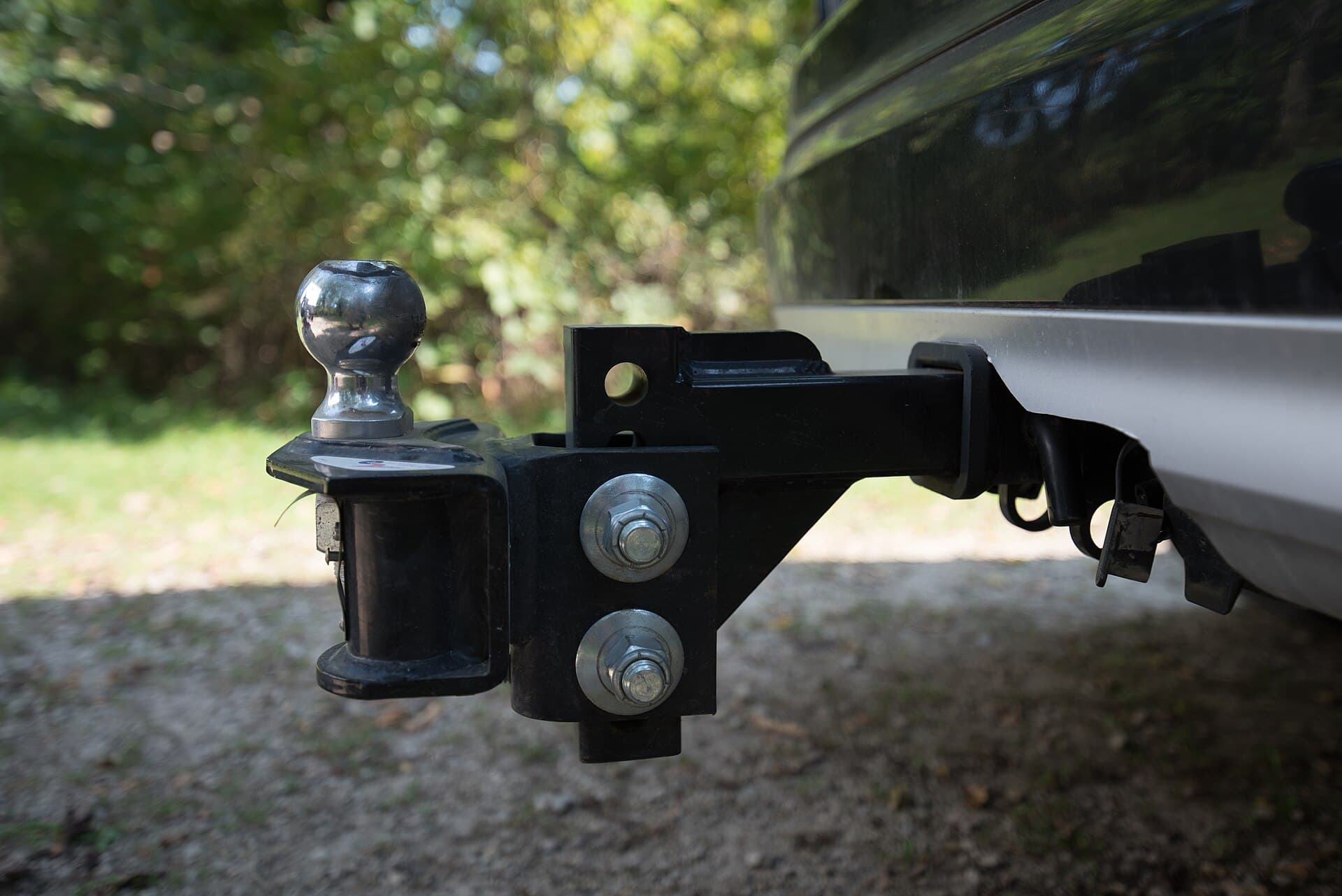
On the Newell north of Parkes the caravan in front of you will tell you whether the hitch is doing work the load should have done. The rear of the dual-cab sits in the wheel arches. The steer tyres look skinny. When a road train goes past, the van steers the ute for a second and the driver corrects late. Someone will later say they need a better sway kit. What they needed first was download in the right place, tyre pressures on a plaque, and a hitch height that did not point the van at the sky.
A weight-distribution hitch is a spring. Sway control is a damper. They are useful Australian tools on heavy light trailers — campers, horse floats, large box vans — and they are some of the most misunderstood hardware on a 50 mm ball. This is a workshop reading. It is not an instruction to fit one, and it is not legal advice about ratings.
What a WDH actually moves
When you drop a laden trailer onto a ball, mass comes off the vehicle’s front axle and goes onto the rear axle and the towbar. That is ordinary physics. On a 2.5-tonne camper with 220 kg on the ball, the front of a dual-cab can lose a lot of the weight that was keeping the steer tyres honest. Headlights lift. Crosswinds get a longer lever. ABS and electronic stability still work, but they work with less front rubber.
A weight-distribution hitch puts spring bars between the coupling head and points on the trailer A-frame. Tensioning those bars lifts the rear of the vehicle a little and puts load back on the front axle. The trailer coupling still carries the download. The road still carries the same total mass. You have moved load forward along the combination, not deleted it.
That is why a WDH does not increase ATM, GTM, GCM, the towbar rating or the ball rating. Anyone selling it as extra towing capacity is selling a flatter illegal combination. Do the match in matching a trailer to your tow vehicle before you spend money on bars.
Sway is a different failure
Sway is yaw. The trailer rotates about the ball and feeds a steer input into the vehicle. Causes that show up on Australian roads, in order of how often they are denied:
- download too low, because the water tank, fuel or toolbox is behind the axle
- a high, narrow load — empty horse float, high van, stacked furniture
- trailer tyre pressures guessed, or a light-truck trailer tyre at car-caravan pressure
- vehicle rear tyres soft under GVM plus download
- coupling high at the vehicle and low at the trailer, so the combination is already steering
- a sudden input: a passing road train, a gust on the Hay Plain, a correction after a corrugation
- play in the ball, the receiver, or a worn override slider
Sway control — friction bars, integrated cam heads, some electronic trailer-brake strategies — resists that rotation. It does not put weight on the front axle. A combination can have excellent sway damping and still unload the steer tyres. It can also have a well-set WDH and still sway if the fridge is on the tailgate.
Electronic stability on the vehicle is a last resort, not a loading method. If the trailer is teaching the vehicle how to steer, stop, load forward, and check pressures. Then decide whether you need hardware.
When a WDH is the right tool
Fit one when all of the following are true.
The combination is inside every rating. You have weighbridge numbers, not hopes.
The vehicle maker allows a WDH. Some handbooks limit bar rating, prohibit them on certain suspensions, or want a specific receiver. Rear airbags, aftermarket trays, body-on-frame lifts and aluminium trays all change the conversation. A WDH on a bar that was never designed for the torsion is a fatigue crack you will meet later.
The front axle measurably unloads when you couple up. Weigh front and rear, coupled and uncoupled. If the front barely changes, you do not have a distribution problem. You may have a sway or height problem.
The trailer is the sort that creates download — a hard-floor or soft-floor camper, a loaded horse float, an enclosed van — not a 750 kg box with a mower in it.
Set-up is then a tape and a scale, not a vibe. Follow the hitch maker’s link drop and chain or cam settings. The aim is a level combination and a front-axle load that resembles the uncoupled vehicle, not a front end that is jammed down so the rear looks “sporty”. Recheck after the first 100 kilometres. Bars settle. So do tyre pressures in the sun.
When a WDH is the wrong tool
Do not use a WDH to hide an overloaded ball. If download is 350 kg on a 250 kg ball, you need to move cargo or choose a different trailer, not wind the bars until the chains sing.
Do not use one on a trailer that must articulate hard: boat ramps, farm gates, off-camber tracks. The bars fight the very movement pintle and off-road couplings exist to allow. Some off-road campers are specifically designed around a WDH-free coupling for that reason.
Do not leave the bars on when reversing into a tight driveway unless the maker says the head allows it. Many do not.
Do not mix a WDH with a worn override coupling and call the result a plant-trailer solution. Override sliders and spring bars are different jobs.
Set the cheap things first
Before you buy a hitch that costs as much as a decent axle, do the unglamorous work.
Load the trailer so download is 8–10 per cent. Water, fuel and tools go forward of the axle. The generator does not live on the rear bumper.
Match hitch height. The trailer floor should run level on the road you actually use. A lifted dual-cab with a standard-height camper is a sway machine.
Set tyre pressures to the load. The trailer plaque and the tyre maker’s tables win. A hot inland afternoon will raise pressure further; start from a cold, laden figure.
Remove play. A 50 mm ball with a flattened throat, a receiver with movement, a loose U-bolt on the spring hanger — all of them yaw.
Use the brake controller. Electric trailer brakes that come in late let the trailer push. A controller set so the combination stays straight under light braking does more for sway than a friction bar on a trailer that is not braking.
Service the running gear. A grabbing drum on one side is a yaw input. So is a bearing on the way out. Keep the yearly service schedule and the bearings, tyres and brakes pieces next to this one.
A note on gadgets and ratings
Integrated “sway plus distribution” heads are common on Australian campers and can work well when they are rated for the ATM and installed to the instructions. Aftermarket add-on friction bars can work on lighter vans. Electronic sway on the vehicle cannot see a trailer that is already past GCM.
None of these devices is a substitute for a coupling and towbar that meet ADR 62. If you add a WDH, you are still on a 50 mm ball with a download limit. Stay inside it.
This is not legal advice and not a fitment manual. Confirm the vehicle handbook, the towbar rating and the hitch maker’s instructions. If a state inspection or a modification sign-off is required for the bar, do that before you tow to Queensland for the holidays.
If the combination still feels wrong after the load, the pressures and a correctly set hitch, the honest next step is to ask whether the trailer is the right trailer. Go back to matching the tow vehicle and, if the coupling itself is the weak point, read 50 mm, pintle and gooseneck. The towing hub collects the rest.
Questions readers ask
- Does a weight-distribution hitch increase how much I can tow?
- No. It redistributes vertical load between the vehicle’s axles. ATM, GTM, GCM, towbar and coupling ratings stay where they were. If you are over those numbers, a WDH makes an illegal combination sit flatter.
- When is a WDH worth fitting?
- When a legal trailer — often a camper or horse float — puts enough download on the ball to unload the steer axle, and the vehicle maker allows a WDH. Weigh the front axle coupled and uncoupled before you buy one.
- Is sway control the same as weight distribution?
- No. Sway control resists the trailer yawing. Some products combine both. A friction bar or integrated cam is not a substitute for 8–10 per cent download, matched tyres and a level coupling.
- Can I use a WDH on a vehicle with rear airbags or a composite tray?
- Only if the vehicle and bar makers say so. Some suspensions, aftermarket trays and towbar designs are incompatible. Check the handbook, then the bar.